Corn Toss Basics
New to the game? Here are the fundamentals of cornhole, also known as corn toss or bean bag toss.
If you’ve been trying to look for a new fun game that you can enjoy with friends and family, then you should check out the game of corn toss. Corn toss is one of the most popular outdoor games today and is known by many names such as bean bag toss, cornhole and soft horseshoes.
The next time you have a barbecue in your lawn or any outdoor gathering with your friends or family, give this game a ‘shoot’; like you would ‘shoot’ a corn bag into the hole of a corn toss board – get it?
Court Layout and Equipment
The cornhole game should be played in a rectangular area that measures about 10 feet in width and 45 feet in length. Both ends of the corn toss court will feature a corn platform. The corn platform will have a designated pitcher’s box on either side. The pitcher’s box is also rectangular in shape and must have dimensions of 4 feet by 3 feet. The pitcher’s box is where the player stands when doing a corn bag pitch.
The corn toss court will also need to have foul lines. These foul lines can be divided into two sets: the open adult and the junior play foul lines. The open adult play foul line is an imaginary mark located about 30 feet from the hole on the opposite platform. For adult play, that puts the two boards 27 feet apart, measured from front edge to front edge. On the other hand, the junior foul line is located about 21 feet from the opposing hole.
The only equipment you will need for playing cornhole is regulation sized bags and two standard size boards for your corn platforms. The products for sale on this site are what we recommend, of course.
What Regulation Boards and Bags Look Like
- Boards are 24 inches by 48 inches, with a 6-inch hole centered 9 inches from the top. The back edge sits 12 inches off the ground and the front edge about 3 to 4 inches, so the board slopes toward the player.
- Wood is the most popular board material, and the surface should be smooth. Bags need to slide, and that won’t happen if the surface has blemishes.
- Regulation bags are 6 inches by 6 inches and weigh about 16 ounces. Bags were traditionally filled with corn; ours are filled with plastic resin, which holds up to the weather.
Fortunately, you don’t need a special field to play. All you need is a flat surface, so set up your boards in a parking lot, your backyard, or wherever else you want to play. One small suggestion: put the boards in a north-south layout. This will help avoid interference from the sun.
Mechanics and Scoring
A game of corn toss can be played in two ways. In a singles game, two contestants play against one another. In a doubles game, one team of two players plays against another team which consists of two players as well. Players on both sides stand on the pitcher’s box and begin tossing or pitching a corn bag alternately. Players toss four corn bags each. For a doubles game, the partners take turns pitching the corn bag. A player only has 20 seconds after entering the pitcher’s box to throw the corn bag.
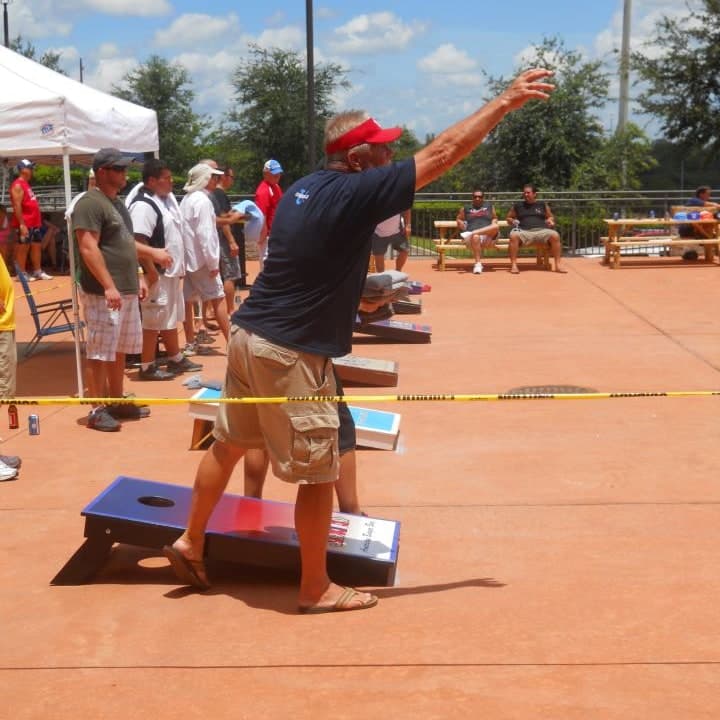
Corn bags that are considered foul will earn zero points. A corn bag is considered foul if the following conditions apply:
- The corn bag was tossed after more than 20 seconds from when the player entered the pitcher’s box.
- The corn bag was tossed after the player has stepped out of the pitcher’s box.
- The corn bag hit an object which is not related to the game.
- The corn bag bounced on the court before hitting the corn platform.
The score of each tossed corn bag will depend on where the corn bag landed. A corn bag that enters the hole is worth three points. A corn bag that lands in the platform, but not inside the hole, is worth one point. Foul corn bags and corn bags that do not land on either the hole or the platform are not worth any points. Keep in mind that tossed corn bags can also cancel out each other in some cases. For instance, if you manage to throw the bag into the hole and so did the other player, then the two similar pitches cancel each other out.
Taking Turns and Winning
- In doubles, one player from each team stands at each board. Those two players alternate tosses until all their bags have been played, then the two players at the other board do the same.
- In singles, both players pitch from the same board, alternating until all bags have been tossed. Then both players move to the other board.
- Toss the bags underhand, one at a time. You can pitch from either pitcher’s box, but you can’t switch boxes until the inning has ended.
- Whoever scored in the previous inning tosses first in the next one. If no one scored, the player or team that tossed last goes first.
- Play continues until one player or team reaches 21 points. A game can’t end in the middle of an inning, so the winner might finish above 21.
A lot of fun can be had while playing corn toss. The game’s mechanics and all the ‘technical’ jibber jabber with regards to the dimensions of the corn bags and the corn toss boards may seem complicated, but they’re really not. As with most things in life, they’re really just there so that there’s some sort of “ground rules” everyone can follow. Once you get past that, you can play all the corn toss games you want in your lifetime without even having to scan through some rule book.
Ready to go deeper? Our complete cornhole guide covers dimensions, distance, and the full rules.
Build Your Own Custom Cornhole Set
Every Custom Corntoss set is built to official regulation specifications. Design your boards and bags exactly how you want them.
Start Designing